
'On the weekly chart, the Nifty 50 index has formed a bearish candle and remains below all short-term moving averages.'

After a stellar 2023, the mutual fund industry sustained its growth momentum in 2024 with an impressive Rs 17 lakh crore surge in assets, driven by buoyant equity markets, robust economic growth, and increasing investor participation. Experts are predicting the positive trend will extend into 2025.

'In the past six months, capital markets have seen a dip, and realty is struggling. The stock-market investor will be cautious of putting that investment in real estate when there may be a slowdown coming.'

'Cancer incidence is projected to increase by 12.8 per cent by 2025 compared with 2020, necessitating more dedicated cancer treatment centres and specialised beds.'

The S&P BSE Realty Index has emerged as one of the top-performing sectors, yielding a remarkable 45 per cent return over the past six months. The three leading players, listed by market capitalisation, have substantially enriched investor wealth by 43-70 per cent during this period. If the second quarter (Q2) of 2023-24 (FY24) updates from Macrotech Developers (Lodha) and Sobha, along with industry data for the quarter, serve as any indication, the trend of strong bookings for larger players is expected to continue.

Institutional investments in Indian real estate have seen a strong start to 2025, with inflows reaching $ 1.3 billion in the first quarter - a 31 per cent year-on-year (YoY) increase. This growth was primarily driven by domestic investments, which accounted for 60 per cent of the total inflows during the quarter. With $ 0.8 billion inflows, domestic investments saw a 75 per cent annual rise and were largely focused on industrial & warehousing and office segments.

Foreign investors have pulled out Rs 44,396 crore from Indian equities this month, driven by strength of the dollar, rising bond yields in the US, and expectations of a weak earnings season. This came following an investment of Rs 15,446 crore in the month of December, data with the depositories showed.

Shares worth over Rs 50,000 crore (or approximately $6 billion) are set to become freely tradable between now and April 10. Historically, such substantial volumes have been absorbed by a buoyant block-deal market.

The exodus of FPIs from the Indian equity markets continues unabated, as they withdrew Rs 64,156 crore ($7.44 billion) this month so far on depreciation of the rupee, rise in the US bond yields and expectation of a tepid earning season. This came after an investment of Rs 15,446 crore in the entire December, data with the depositories showed.

'Adventure travel, cultural tours, and wellness retreats are in high demand.'

From the 30-share Sensex pack, Infosys, ICICI Bank, Kotak Mahindra Bank, Mahindra & Mahindra, State Bank of India, HCL Technologies, Axis Bank, NTPC and HDFC Bank were among the laggards. In contrast, Maruti, IndusInd Bank, Adani Ports, ITC and UltraTech Cement defied broader market trends and ended in positive territory.

Stock market investors became richer by a whopping Rs 77.66 lakh crore in 2024, helped by an overall optimistic trend in equities, where the BSE Sensex surged over 8 per cent. Analysts said the year witnessed a tug of war between the bulls and bears marked by volatility but, despite the uncertainties around the world, the Indian markets sustained the pressure and delivered impressive returns.

A lower risk appetite among investors has driven gold, traditionally a safe-haven asset, to record highs so far this year. Fuelled by geopolitical tensions in West Asia, robust demand from central banks - particularly in Asia - and US President Donald Trump's tariff volleys, spot gold touched an all-time high of $2,956 per ounce on February 24 in the international markets.

Homegrown fast-moving consumer goods (FMCG) major Dabur India is set to record low single-digit growth in consolidated revenue in the December quarter, it said in an update on Friday. The maker of Hajmola candy and Real fruit juice said rural consumption continued to be resilient and grow faster than urban in the third quarter.

The growth was primarily driven by domestic investments, which accounted for 60 per cent of the total inflows during the first quarter of the financial year.

ICICI Prudential Life Insurance (IPRU) disappointed the market even though some analysts said the Q3FY25 results were in line. Most analysts cut margin estimates. The insurer reported M9FY25 growth of 8.5 per cent year-on-year (Y-o-Y) in value of new business (VNB) premium to Rs 1,575 crore, while total annual premium equivalent (APE) grew 27.2 per cent to Rs 6,910 crore.

The FMCG industry hopes for a revival in consumption growth in 2025 with some 'green shoots' already visible, after having a challenging year amid escalating input costs and a double-digit rise in food inflation, which ultimately slowed down the pace of the urban market growth in the second half of 2024. Soaring prices of commodities such as palm oil, coffee, cocoa and wheat forced FMCG players to go for a hike of 3 to 5 per cent or resort to shrinkflation by reducing pack sizes and grammage to retain attractive price points, fearing a volume loss.

Godrej Consumer Products (GCPL) had a disappointing third quarter (Q3FY25) with flat volumes (after 7 per cent growth H1FY25). Price hikes will be required to maintain margins to offset the cost of palm oil inflation. However, some analysts see Q3 as an exception with strong volume growth expected to resume and it may be the fastest growing FMCG player in FY26.
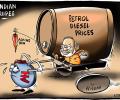
Price of international crude oil - the raw material for making petrol and diesel - dropped to a three-year low before marginally recovering but a revision in domestic petrol and diesel rates is likely only if lower rates are sustained, industry sources and officials said. Global oil benchmark Brent crude futures fell below $70 per barrel on Tuesday - the first time since December 2021 - but gained thereafter after Hurricane Francine hit crude supply in the Gulf of Mexico. Brent rose above $71 a barrel on Thursday while West Texas Intermediate advanced to trade near $68.

Quarterly earnings from corporates, global trends, and trading activity of foreign investors will guide market sentiment this week, analysts said, adding that benchmark indices may face volatile trends. "The upcoming release of Q2 results will be closely watched, providing insights into corporate performance. "Meanwhile, the escalating tensions between Israel and Iran introduce a significant geopolitical risk, potentially leading to increased oil prices and market volatility.

Organisations that reward constant optimism and penalise negativity create environments where employees feel pressured to hide their struggles, notes Sonica Aron, founder of HR consultancy firm Marching Sheep.
Investors became richer by nearly Rs 8 lakh crore on Wednesday as benchmark BSE Sensex surged by 740 points amid value buying in utilities and power shares and a strong trend in global markets. The 30-share BSE Sensex surged by 740.30 points or 1.01 per cent to close at 73,730.23.

Havells India, the country's largest listed consumer electrical company, reported a mixed performance in the 2024-25 (FY25) October-December quarter (Q3). While the top line benefited from festival demand, lower margins impacted operational performance.

Domestic steel prices have seen an increase over the past couple of months in anticipation of a safeguard duty, but a looming global trade war is likely to weigh as threat of import rises and prospect of export flounders. Data from BigMint showed that in March 2025, hot rolled coil (HRC) prices ex-Mumbai increased by Rs 600 per tonne month-on-month (M-o-M), rising from Rs 48,400 per tonne in February to Rs 49,000 per tonne.

Latest GDP growth numbers a one-off development and not the beginning of a trend, says CEA V Anantha Nageswaran.

From the 30 Sensex firms, Mahindra & Mahindra, Infosys, Kotak Mahindra Bank, JSW Steel, Adani Ports, Tata Motors, Adani Ports, ITC and Titan were the major laggards. HDFC Bank, Bharti Airtel, Reliance Industries, Asian Paints and State Bank of India were the gainers.

'The jury panel said that my collection should not be limited to a college fashion show; it had much more potential. They encouraged me to sign up for the annual National Designer Awards organised by the World Designing Forum.'

'Each state is unique, but when it comes to finance, the fundamentals cannot be different.'

Equity indices slipped in the negative territory on Wednesday after a two-day breather, with the BSE Sensex tumbling 709.54 points following weak trends in global markets. Unabated foreign fund outflows also played spoilsport for the bourses. The 30-share BSE Sensex tanked 709.54 points or 1.35 per cent to settle at 51,822.53. During the day, it declined 792.09 points or 1.50 per cent to 51,739.98.

It was a low weekend for Yudhra as Rs 8 crore (Rs 80 million) came in at the box office.

After a robust 2023, foreign investors significantly scaled back their investments in Indian equities in 2024, with net inflows amounting to over Rs 5,000 crore, as elevated domestic valuations, coupled with geopolitical uncertainties prompted investors to adopt a more cautious stance. Looking ahead to 2025, FPI flows into Indian equities could see a recovery, supported by a cyclical upswing in corporate earnings, particularly in domestic-oriented sectors like capital goods, manufacturing, and infrastructure, Vinit Bolinjkar, head of research, Ventura Securities, said.

Manmohan Singh, the former prime minister of India and architect of the country's economic reforms, passed away on Thursday night at the age of 92. Born in a village in undivided Punjab, now in Pakistan, Singh's family witnessed first-hand the tragic Partition. Throughout his long public life, he often spoke of communal harmony and democratic values. He served two terms as prime minister from 2004 to 2014 and was known for his wisdom and quiet demeanor.

Quick commerce (qcom) industry is poised to lead gig workforce hiring in 2025, propelled by a surge in demand for faster deliveries, expansion by existing players, entry of new competitors, and evolving consumer preferences in the post-pandemic era, according to industry experts. The qcom industry currently employs nearly 260,000 people - around 200,000 delivery personnel and 60,000 dark store workers, according to TeamLease Staffing.

'We want to hide it (by saying) we are too busy in our lives, we have other things to attend to, we have families.' 'But they all had families, including Jyotiba or Mahatma Gandhi, or anybody who challenged the system.'

FMCG major Hindustan Unilever Ltd on Wednesday reported a 19.18 per cent rise in consolidated net profit at Rs 2,989 crore in the December quarter.

The stock of mall developer and commercial real estate major, The Phoenix Mills (Phoenix), is up 26 per cent since its business update in the third week of January. The gains came on strong December quarter performance and the consumption boost in the Budget which is expected to help the company sustain its growth trends.

Foreign investors have made a strong comeback to Indian equities with a net investment of Rs 22,766 crore in the first two weeks of December driven by expectations of rate cut by the US Federal Reserve. This revival follows significant outflows in the preceding months, with Foreign Portfolio Investors (FPIs) pulling out a net Rs 21,612 crore in November and a massive Rs 94,017 crore in October -- the worst monthly outflow on record.

'While investors need to be prepared for making some losses, they should not lose big money chasing euphoria amid fear of missing out.'

With just four trading sessions to go for the ITC-ITC Hotels demerger record date shares of ITC continue to consolidate in a thin range of Rs 460 - Rs 480 in an otherwise volatile equity market. On Tuesday thus far despite a near 1 per cent fall in the Sensex and Nifty; ITC traded on a flat note. ITC had set the demerger ratio at 1:10 - meaning 1 share of ITC Hotels for every 10 shares of ITC as of the record date January 6, 2025.

'Regardless of whether you invest Rs 100 or Rs 1 crore per month, risk is inevitable.' 'Positive returns at the end of the year can never be guaranteed.' 'This is a fundamental truth every SIP investor must grasp.'
